


Murchison Falls National Park is Uganda’s largest and oldest protected area, covering 3,840 square kilometers of rolling savanna, riverine woodland, and dense tropical forest. At its heart lies one of the natural world’s most dramatic spectacles: the entire Victoria Nile forces itself through a rocky gorge just seven meters wide before plunging 43 meters into a frothing pool below. The result is a wall of mist, a thundering roar, and a sight that has drawn explorers, naturalists, and safari travelers for over a century.
Whether you are here for the legendary Nile boat cruise, world-class game drives on the northern savanna, chimpanzee trekking in Budongo Forest, or the chance to track white rhinos on foot at Ziwa Rhino Sanctuary, Murchison Falls delivers one of the most complete safari experiences in East Africa.
This guide covers everything you need to plan your visit in 2026, from activities and wildlife to costs, accommodation, and the best time to go.
Why Murchison Falls National Park is Special
Murchison Falls sits within the larger Murchison Falls Conservation Area, which also includes Bugungu Wildlife Reserve to the south and Karuma Wildlife Reserve to the east. Together, this protected landscape covers over 5,000 square kilometers, making it one of the largest conservation zones in East Africa.
The Victoria Nile bisects the park as it flows from Lake Victoria in the southeast toward Lake Albert in the northwest. This geographic divide creates two distinct safari zones:
- The northern bank is open savanna grassland, home to the park’s densest concentrations of large mammals. This is where you will find lions, giraffes, elephants, buffalo herds, and thousands of Uganda kob.
- The southern bank is denser woodland and forest, including sections of Budongo Forest, one of East Africa’s most important primate habitats.
The falls themselves sit roughly in the center of the park, near the Paraa crossing point where a vehicle ferry connects the two banks. Most safari itineraries use Paraa as a base, allowing easy access to both game drives and the boat cruise.
What sets Murchison Falls apart from other Uganda destinations is the sheer variety of experiences available in a single park. In three days you can cruise the Nile past hippos and crocodiles, drive through open plains teeming with big game, track chimpanzees through ancient mahogany forest, hike to the top of one of Africa’s most powerful waterfalls, search for the elusive shoebill stork, and even try sport fishing on the Nile. Few parks anywhere on the continent offer that range.
The Nile Boat Cruise: Murchison’s Signature Experience
The three-hour boat cruise upstream from Paraa to the base of Murchison Falls is, for most visitors, the single most memorable experience in the park. It is also one of the finest wildlife boat trips in all of Africa.
What to Expect
The cruise departs from the Paraa jetty (typically at 09:00 or 14:00) and heads east along the Victoria Nile toward the falls. The river here is wide and slow, lined with papyrus, palm trees, and sandy banks. As you move upstream, the concentration of wildlife along the riverbanks builds steadily.
Hippos are the stars of the first half of the journey. Pods of 20 to 50 hippos wallow in the shallows, yawning, snorting, and occasionally charging at each other in territorial disputes. The Nile in Murchison Falls holds one of the densest hippo populations in East Africa.
Nile crocodiles, some of them enormous, bask on sandy banks just meters from the boat. You will also see elephants drinking and bathing at the water’s edge, waterbuck grazing on the banks, and buffalo herds cooling off in the shallows during the heat of the day.
The birdlife along the river is extraordinary. African Fish Eagles perch on overhanging branches, Goliath Herons stand motionless in the reeds, pied kingfishers hover and dive, and malachite kingfishers flash electric blue along the papyrus fringe. If you are lucky, you may spot a rock pratincole nesting on the boulders near the falls.
The Climax: The Base of the Falls
As the boat rounds the final bend, the roar of the falls grows louder and the mist becomes visible above the gorge. The boat anchors as close as safely possible to the base, giving you time to photograph the cascade and feel the spray on your face. The power of the Nile compressed through that narrow seven-meter gap is genuinely awe-inspiring. Water explodes from the gorge with tremendous force, creating a permanent rainbow in the mist on sunny days.
Practical Details
- Duration: Approximately 3 hours
- Cost: $30 per person (2026 rate), plus park entry
- What to bring: Sunscreen, hat, sunglasses, rain jacket (for spray near the falls), binoculars, and a camera with a zoom lens
- Tip: The afternoon cruise (14:00) often has softer light for photography and slightly fewer boats, but the morning departure (09:00) gives you time for a game drive in the afternoon
Game Drives on the Northern Bank
The open savanna north of the Victoria Nile is where Murchison Falls reveals its big-game credentials. The landscape here is classic East African bush: golden grasslands punctuated by borassus palms, scattered acacia woodland, and seasonal wetlands that draw huge concentrations of herbivores.
What You Will See
Murchison Falls is home to 144 mammal species, and the northern bank is where the majority of the large, visible species concentrate.
Rothschild’s giraffe is perhaps the most special sighting here. This endangered subspecies, distinguished by its pale coloring and lack of markings below the knee, is found in only three locations in Uganda. Murchison Falls holds the country’s largest population, and sightings on the northern plains are frequent and often close.
Elephants are present in large numbers, with an estimated 900 or more individuals in the park. Herds of 20 to 40 are common on the northern savanna, and lone bulls patrol the riverine woodland near the Nile.
Buffalo are everywhere. Murchison Falls supports over 10,000 buffalo, and herds of several hundred are a regular sight on morning and afternoon drives.
Uganda kob, the country’s national antelope, are present in staggering numbers, with an estimated 35,000 or more in the park. The kob breeding grounds (known as “leks”) on the northern plains are fascinating to watch: dominant males defend small territories while females move between them.
Lions are the top predator on the northern bank. Prides are regularly seen resting under palms or stalking kob herds in the early morning. Leopards are present but far more elusive, typically spotted along the edges of woodland and riverine forest.
Spotted hyenas are common, and you may see them on both day and night drives. Jackals, warthogs, waterbuck, hartebeest, and oribi round out the herbivore list.
The “Big Four” (and How to Make It Five)
Murchison Falls is often described as a “Big Four” park because it has lion, leopard, elephant, and buffalo but no rhinos within its boundaries. However, by combining your Murchison visit with a stop at Ziwa Rhino Sanctuary (covered in detail below), you can complete the Big Five experience on a single trip. This is exactly how most safari packages to Murchison are structured.
Game Drive Routes
The main game drive circuit on the northern bank follows a network of tracks through the Buligi area, between the Albert Nile to the west and the Victoria Nile to the south. Key areas include:
- Buligi Peninsula: The most productive area for lions, giraffes, and large elephant herds. The peninsula juts out between the two sections of the Nile and supports excellent concentrations of game.
- Albert Delta: Where the Victoria Nile enters Lake Albert. This marshy, papyrus-fringed area is the best location in the park for shoebill stork sightings (more on this below).
- Queens Track and Paraa to Pakuba road: Good for general game viewing, with regular sightings of buffalo, kob, and waterbuck.
Practical Details
- Duration: Half-day drives (3 to 4 hours) or full-day drives with a packed lunch
- Best time: Early morning (06:30 departure) or late afternoon (15:30) for active predators and cooler temperatures
- Vehicle: A 4x4 with a pop-up roof is essential for photography and visibility. Car rental with driver-guide is the standard arrangement for Murchison safaris.
Hiking to the Top of Murchison Falls
While the boat cruise shows you the falls from below, the hike to the top gives you an entirely different perspective, one that is equally dramatic.
The Trail
The hike begins near Paraa and follows a trail along the south bank of the Nile upstream toward the falls. The walk takes roughly 45 minutes at a moderate pace and passes through riverine forest and open rocky sections with views over the river.
At the top, you stand on the edge of the narrow gorge and look straight down into the seven-meter gap where the entire Nile squeezes through. The volume of water, the noise, and the force of the current are mesmerizing. You can feel the vibration through the rock beneath your feet.
A viewpoint platform allows you to watch the water funnel into the gorge and explode outward on the other side. On a clear day, the view extends downstream along the Nile toward Paraa.
Practical Details
- Duration: 45 minutes to 1 hour one way
- Difficulty: Moderate. The trail is mostly flat with some rocky sections.
- Guide: A park ranger accompanies all hikers
- Tip: Combine this with the boat cruise for a complete falls experience. Many itineraries include a morning boat cruise followed by an afternoon hike (or vice versa), allowing you to see the falls from both perspectives in a single day.
- What to bring: Sturdy walking shoes, water, hat, and camera
Searching for the Shoebill Stork
The shoebill is one of Africa’s most sought-after birds, a prehistoric-looking, shoe-shaped-billed giant that stands over a meter tall and moves with an eerie, deliberate stillness. For serious birdwatchers, seeing a shoebill in the wild is a bucket-list moment, and Murchison Falls is one of the best places on the continent to find one.
Where to Look
The primary shoebill habitat in Murchison Falls is the swampy delta where the Victoria Nile flows into Lake Albert, on the park’s northwestern edge. A dedicated shoebill boat trip departs from the northern bank and heads downstream toward the delta, navigating through channels of papyrus and floating vegetation.
Shoebills are solitary, territorial, and not always easy to find. However, experienced local guides know their favored fishing spots, and sighting success rates on dedicated trips are high (typically 70% or better during the dry season).
Other Notable Birds
With 556 recorded bird species, Murchison Falls is one of Uganda’s premier birding destinations. Beyond the shoebill, highlights include:
- African Fish Eagle: Abundant along the Nile. Their distinctive call is the soundtrack of the boat cruise.
- Goliath Heron: Africa’s largest heron, frequently seen fishing in the shallows.
- Grey-crowned Crane: Uganda’s national bird, elegant and unmistakable with its golden crown.
- Abyssinian Ground Hornbill: A massive, ground-dwelling bird found on the northern savanna. Often seen in small family groups walking through the grass.
- 53 raptor species: Including martial eagle, bateleur, African hawk-eagle, and several vulture species.
- Migratory species: The wet season (March to May, October to November) brings European and Asian migrants, pushing the bird list even higher.
A three-day visit to Murchison Falls can realistically yield 150 to 200 bird species for an active birder.
Chimpanzee Trekking in Budongo Forest
Budongo Forest Reserve, on the southern edge of the Murchison Falls Conservation Area, is one of East Africa’s most important tropical forests and a world-class destination for primate safaris. The forest covers approximately 800 square kilometers and contains some of the largest mahogany trees in East Africa, with canopy heights reaching over 50 meters.
The Chimpanzees
Budongo is home to over 600 chimpanzees, making it one of the largest chimp populations in Uganda. Two habituated communities are available for tracking:
- Kaniyo Pabidi (on the park’s eastern edge): A smaller community with good habituation. Treks here are slightly less crowded and the forest terrain is relatively gentle.
- Budongo Central Forest Reserve (the main research site): Home to the Sonso community, which has been studied continuously since the 1990s. These chimps are extremely well habituated and encounters are typically close and prolonged.
What a Chimp Trek Looks Like
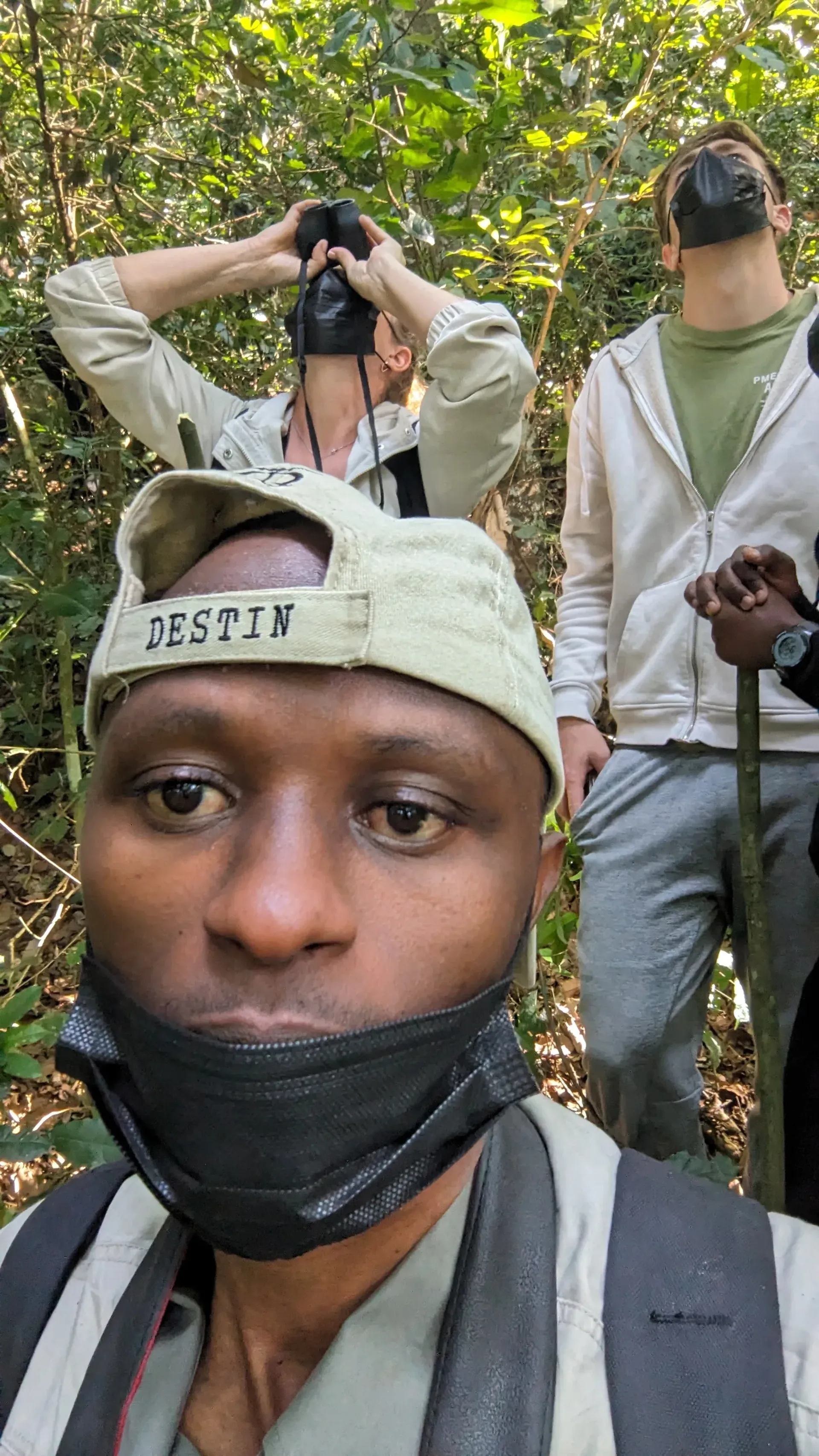
Trekking groups are limited to a small number of visitors, accompanied by trained guides and trackers. You set out on foot into the forest, following trails and listening for the calls, hoots, and drumming (chimps pound on buttress roots) that reveal the chimps’ location.
Once found, you spend up to one hour with the group. Chimps are dynamic and expressive: you may see grooming sessions, play fights among juveniles, adults cracking open figs high in the canopy, or the dramatic “pant-hoot” display calls that echo through the forest.
The forest itself is magnificent. Towering ironwood and mahogany trees form a cathedral-like canopy, shafts of light filter through gaps in the foliage, and the air is rich with the sounds of insects, frogs, and forest birds. Budongo holds 360 bird species, including the Yellow-footed Flycatcher and Puvel’s Illadopsis, both of which are difficult to find elsewhere in East Africa.
Practical Details
- Cost: $50 per person for chimp tracking in Budongo (2026 rate)
- Duration: 2 to 6 hours depending on where the chimps are
- Fitness level: Moderate. The terrain is uneven forest floor with roots and mud, but it is not steep climbing.
- What to bring: Long trousers, long-sleeved shirt, sturdy hiking shoes or boots, rain jacket, insect repellent, water, and a camera (no flash)
- Minimum age: 12 years for chimpanzee trekking
Night Game Drives
When the sun sets over the northern savanna, Murchison Falls transforms. Animals that are invisible during the day emerge, and familiar daytime species behave in entirely different ways. A night drive is one of the most exciting additions to a Murchison itinerary.
What Comes Out at Night
- Lions: Murchison’s lions do most of their hunting after dark. Seeing a pride on the move, stalking through the grass with focused intensity, is a completely different experience from watching them sleep under a palm during the day.
- Leopards: Your best chance of seeing a leopard in Murchison Falls is on a night drive. These elusive cats emerge at dusk to hunt along the edges of woodland and riverine forest.
- Hippos: Out of the water and grazing on the plains, hippos at night look like enormous, lumbering boulders moving across the savanna.
- Spotted hyenas: Active and vocal, often seen trotting along roads or investigating lion kills.
- African civets: Beautifully marked, cat-like creatures that are strictly nocturnal and relatively common on the northern bank.
- Genets: Small, spotted, and incredibly agile, genets are frequently caught in spotlights as they move through trees.
- Porcupines: Large crested porcupines waddle along tracks, their quills rattling when they sense the vehicle.
- Bush babies (galagos): Their enormous reflective eyes glow bright orange in the spotlight, and their calls are one of the iconic sounds of the African night.
Practical Details
- Cost: $30 per person (2026 rate)
- Duration: 2 to 3 hours, departing around 19:00
- Equipment: The guide uses a handheld spotlight to scan for eyeshine. Bring warm layers, as temperatures drop after sunset.
Ziwa Rhino Sanctuary: Completing the Big Five
No visit to Murchison Falls is truly complete without a stop at Ziwa Rhino Sanctuary, the only place in Uganda where you can see wild rhinos. Located in Nakasongola district, roughly halfway between Kampala and Murchison Falls along the main highway, Ziwa is a natural stopover on the drive to or from the park.
The Story of Ziwa
Uganda’s wild rhinos were wiped out by poaching and civil conflict by the 1980s. The Rhino Fund Uganda established Ziwa in 1998 as a breeding and reintroduction program. Starting with a small number of southern white rhinos translocated from Kenya and the United States, the sanctuary has steadily grown its population. Today, Ziwa is home to a thriving group of white rhinos living in semi-wild conditions within a fenced but vast reserve of savanna and wetland.
The long-term goal is to reintroduce rhinos into Uganda’s national parks, including Murchison Falls itself, restoring the Big Five to the country’s premier safari destination.
The Tracking Experience
Rhino tracking at Ziwa is done entirely on foot. You join a trained sanctuary ranger and walk through the bush, following fresh tracks, dung, and feeding signs until you locate a rhino group. The walking approach is quiet and respectful, and encounters are typically at 20 to 30 meters, sometimes closer.
Standing on foot in open savanna, watching a two-ton white rhino graze calmly just meters away, is a profoundly different experience from viewing animals from a vehicle. The sense of proximity and the silence (no engine noise, no rumbling tires) make it one of the most intimate wildlife encounters available in East Africa.
Practical Details
- Location: Nakasongola, approximately 170 km north of Kampala on the Kampala-Gulu highway
- Duration: Tracking takes 1 to 2 hours. Most visitors stop on the way to or from Murchison Falls.
- Cost: Entry and tracking fees apply (check current rates at the sanctuary)
- What to bring: Walking shoes, hat, sunscreen, water, binoculars, camera
- Tip: An early morning visit (07:00) gives the best light and cooler walking conditions
Sport Fishing on the Nile
For something completely different, Murchison Falls offers some of the best freshwater sport fishing in Africa. The turbulent waters below the falls are home to enormous Nile perch, with fish regularly exceeding 50 kilograms and the occasional giant topping 100 kilograms.
Fishing is catch-and-release, and sessions are conducted from boats below the falls. The combination of fishing in one of Africa’s wildest settings, with hippos, crocodiles, and the roar of the falls as your backdrop, makes this a genuinely unique experience.
Cultural Village Visits
Several communities around Murchison Falls offer cultural tourism experiences. Visits typically include traditional dance performances, demonstrations of local crafts (basket weaving, bark cloth making), storytelling, and shared meals. These encounters provide context for the human history of the region and offer direct economic benefits to communities living alongside the park.
Your guide can arrange cultural visits as part of a broader Murchison itinerary. They work well as a half-day activity between morning and afternoon game drives.
Best Time to Visit Murchison Falls
Dry Seasons: December to February and June to September
The dry months are the classic safari season at Murchison Falls. During these periods:
- Animals concentrate around permanent water sources (the Nile and its tributaries), making them easier to find on game drives
- Roads are in their best condition, and all areas of the park are accessible by 4x4
- Vegetation is shorter and thinner, improving visibility on the savanna
- The boat cruise is at its most productive, with large numbers of animals along the riverbanks
December to February is the peak season, coinciding with European and North American winter holidays. Accommodation books up quickly, so advance reservations are important.
June to September is equally good for wildlife viewing and often slightly less crowded.
Wet Seasons: March to May and October to November
The rainy months bring lush green landscapes, dramatic skies, and excellent birding. Migratory species arrive from Europe and Asia, pushing the park’s bird list to its maximum. However, some secondary tracks on the northern bank may become muddy or impassable, and game is more dispersed across the landscape.
The wet season is a good choice for visitors who prioritize birding, photography (green backdrops and dramatic light), and lower prices at lodges.
Year-Round Constants
The Nile boat cruise operates year-round and is productive in every season. The falls themselves are most powerful during and just after the wet season, when the Nile’s volume peaks.
Getting to Murchison Falls
By Road from Kampala
The most common approach is by road from Kampala or Entebbe. The distance is approximately 300 kilometers, and the drive takes 5 to 6 hours depending on traffic in the Kampala suburbs and road conditions.
The route heads north through Luwero, Nakasongola (where you can stop at Ziwa Rhino Sanctuary), and Karuma. At Karuma, you turn west and enter the park through the Karuma (Tangi) gate or continue to the Kichumbanyobo gate for access to the southern bank.
A 4x4 vehicle is recommended at all times and essential during the wet season. The highway to Karuma is tarmac and in good condition, but roads within the park are murram (laterite) and can be challenging in rain.
By Domestic Flight
For visitors short on time, chartered and scheduled flights connect Entebbe International Airport with airstrips inside or near the park:
- Pakuba Airstrip: On the northern bank, close to several lodges and the game drive circuits
- Bugungu Airstrip: On the southern side, with road transfers to Paraa
Flight time from Entebbe is approximately one hour. This option eliminates the long drive and allows you to maximize your time in the park.
Combining with Other Destinations
Murchison Falls works well as part of a longer Uganda safari itinerary:
- From Kigali (Rwanda): Drive through western Uganda via Fort Portal and Kibale Forest, visiting chimp trekking and crater lakes before continuing north to Murchison. This is a popular routing for travelers combining Rwanda and Uganda.
- From Bwindi Impenetrable Forest: After gorilla trekking, head north through Queen Elizabeth National Park and Kibale before reaching Murchison.
- From Jinja: The adventure capital of Uganda (white-water rafting, bungee jumping) is roughly 4 to 5 hours from the park’s eastern gates.
Where to Stay: Accommodation Guide
Murchison Falls has accommodation for every budget level, from luxury riverfront lodges to basic campsites. Most options cluster around the Paraa area on both banks of the Nile.
Luxury Lodges ($250 to $500+ per night)
Baker’s Lodge is a standout, positioned directly on the south bank of the Victoria Nile with unobstructed views of the river. Each suite has a private veranda overlooking the water, and hippos graze on the lawn at night. The lodge is named after Sir Samuel Baker, the explorer who named the falls in 1864.
Paraa Safari Lodge is the park’s largest and most established property, with 54 rooms on the north bank near the Paraa ferry crossing. It has a swimming pool, bar with river views, and direct access to game drive circuits. It is a solid, well-run operation with a long history.
Chobe Safari Lodge is a 4-star property on the north bank with a spa, riverside pool, and comfortable rooms. It offers a slightly more polished experience than Paraa Safari Lodge and is well suited to travelers who want a higher level of service.
Kulu Ora is a newer boutique lodge on a hilltop with panoramic views over the park. Private plunge pools for each room, excellent food, and an intimate atmosphere make it one of the most exclusive options in the Murchison area.
Mid-Range Lodges ($100 to $250 per night)
Twiga Safari Lodge offers comfortable banda-style accommodation on the south bank with good value for money.
Murchison River Lodge is a solar-powered eco-lodge on the south bank, popular with environmentally conscious travelers. Rooms are well-appointed and the grounds are lovely.
Pakuba Safari Lodge sits in a scenic location on the north bank with easy access to game drives.
Sambiya River Lodge is set in the forest near Budongo, making it a good base for combining game drives with chimpanzee trekking.
Nile Safari Lodge provides solid mid-range accommodation with river views and a central location.
Budget Options ($40 to $100 per night)
Red Chilli Rest Camp is the go-to for backpackers and budget travelers. Located on the south bank near Paraa, it offers dormitory beds, basic private rooms, and a campsite. The bar and restaurant are a social hub for travelers.
Fort Murchison provides simple but comfortable rooms on the south bank.
Budongo Ecolodge is an excellent choice for visitors focused on chimpanzee trekking, located within the forest reserve.
UWA Campsites are available at several locations within the park for self-sufficient campers with their own equipment.
Booking Tips
- In peak season (December to February, July to August), book luxury and mid-range lodges at least 2 to 3 months in advance
- Budget options are generally available on shorter notice, but Red Chilli fills up quickly during holiday periods
- Most lodges can arrange game drives, boat cruises, and chimp trekking directly, or you can book through your tour operator
Costs and Budget Planning (2026 Rates)
Understanding the costs involved helps you plan a realistic budget for your Murchison Falls safari.
Park Fees
- Park entry: $45 per day for foreign non-residents
- Nile boat cruise: $30 per person
- Night game drive: $30 per person
- Chimpanzee trekking (Budongo): $50 per person
Safari Package Prices
The most practical and cost-effective way to visit Murchison Falls is through an organized safari package that bundles transport, accommodation, park fees, activities, and guide services.
- Budget safari (3 days/2 nights): From $450 per person sharing. Includes Red Chilli or similar budget accommodation, basic meals, a game drive, and the boat cruise.
- Mid-range safari (3 days/2 nights): $600 to $900 per person sharing. Includes a mid-range lodge, full board, multiple game drives, the boat cruise, and typically a Ziwa Rhino stop.
- Luxury safari (3 days/2 nights): From $1,200 per person sharing. Includes a premium lodge, full board with drinks, private vehicle and guide, all activities, and transfers.
Longer itineraries that combine Murchison Falls with other Ugandan parks (Kibale, Bwindi, Queen Elizabeth) offer better per-day value and a more complete experience of Uganda’s wildlife diversity.
What Is Included in a Typical Package
Most organized safaris include:
- Return transport from Kampala or Entebbe in a 4x4 safari vehicle
- Accommodation and meals as specified
- Park entry fees
- Game drives with an English-speaking driver-guide
- Nile boat cruise
- Drinking water in the vehicle
Activities such as chimpanzee trekking, night drives, and the shoebill trip are sometimes included and sometimes offered as optional add-ons. Check the details of your specific package.
What to Pack for Murchison Falls
A well-packed bag makes a meaningful difference to your comfort and enjoyment. Here is what to bring:
Clothing:
- Lightweight, neutral-colored clothing (khaki, olive, beige) for game drives
- Long trousers and long-sleeved shirts for chimp trekking and insect protection
- A warm fleece or jacket for early morning drives and evenings
- A rain jacket (useful year-round, essential in wet season)
- Comfortable walking shoes for the falls hike and rhino tracking
- A wide-brimmed hat and sunglasses
Gear:
- Binoculars (essential for birdwatching and distant wildlife)
- Camera with a telephoto lens (200mm minimum, 400mm ideal for wildlife)
- Extra memory cards and batteries
- A headlamp or small torch for night use in camps and lodges
- Reusable water bottle
- Daypack for hikes and walking activities
Health and Comfort:
- Sunscreen (SPF 30+)
- Insect repellent with DEET
- Antimalarial medication (Murchison Falls is in a malaria zone; consult your doctor before travel)
- Personal first-aid kit with any prescription medications
- Hand sanitizer
Combining Murchison Falls with Other Uganda Destinations
Murchison Falls is spectacular on its own, but it becomes even more rewarding as part of a broader Uganda safari. Here are the most popular combinations:
Murchison Falls plus Kibale Forest (Chimpanzees)
Kibale Forest National Park, near Fort Portal in western Uganda, holds the highest density of primates in Africa and offers the best chimpanzee trekking experience in the country. Combining Murchison’s big game and Nile scenery with Kibale’s intimate forest encounters creates a beautifully balanced itinerary. Allow 7 to 8 days for a comfortable pace.
Murchison Falls plus Bwindi (Gorilla Trekking)
For the ultimate Ugandan wildlife trip, combine Murchison Falls with gorilla trekking in Bwindi Impenetrable National Park. This itinerary typically runs 8 to 10 days and includes the full spectrum: savanna game drives, the Nile cruise, chimpanzees, and mountain gorillas. It is ambitious but unforgettable.
Murchison Falls plus Queen Elizabeth National Park
These two parks complement each other perfectly. Queen Elizabeth National Park offers tree-climbing lions in the Ishasha sector, the Kazinga Channel boat cruise, and the Kyambura Gorge chimps. Together with Murchison, you cover Uganda’s two most important savanna parks. A combined itinerary runs 5 to 7 days.
Murchison Falls plus Jinja
For travelers who want to mix wildlife with adventure, add a day or two in Jinja for white-water rafting on the Nile, bungee jumping, or kayaking. Jinja is roughly 4 to 5 hours east of the park and works well as a first or last stop.
The Grand Uganda Circuit
The most comprehensive Uganda safari combines Murchison Falls, Kibale Forest, Queen Elizabeth National Park, Bwindi Impenetrable Forest, and Lake Bunyonyi over 12 to 16 days. This covers gorillas, chimps, tree-climbing lions, big savanna game, the Nile boat cruise, and crater lakes. East Africa Bridge Tours specializes in designing these multi-park itineraries, handling logistics, permits, and accommodation so you can focus on the experience.
Frequently Asked Questions
Is Murchison Falls safe? Yes. The park is well managed by the Uganda Wildlife Authority, and all activities are conducted with trained guides and rangers. The main safety considerations are standard safari ones: follow your guide’s instructions, stay in the vehicle during game drives, and do not approach animals on foot outside of guided walking activities.
How many days do I need? A minimum of 2 nights (3 days) allows you to do a game drive, the boat cruise, and the falls hike. Three nights gives you time to add chimpanzee trekking or a night drive. If you include Ziwa Rhino Sanctuary on the way, add half a day.
Can I visit Murchison Falls as a day trip from Kampala? It is technically possible but not recommended. The 5 to 6 hour drive each way leaves almost no time in the park. Two nights is the practical minimum.
Do I need a guide? Self-driving is permitted, but a knowledgeable driver-guide dramatically improves your experience. Guides know where animals are, can identify birds and tracks, handle park logistics, and navigate the sometimes-challenging roads. East Africa Bridge Tours provides experienced, English-speaking driver-guides for all Murchison itineraries.
What about tipping? Tipping is customary in Uganda’s safari industry. Standard guidelines are $10 to $20 per day for your driver-guide and $5 to $10 per day for lodge staff, though this is always at your discretion.
Is Murchison Falls suitable for children? Yes, with some caveats. Children of all ages can enjoy game drives and the boat cruise. However, chimpanzee trekking in Budongo has a minimum age of 12, and some walking activities may not be suitable for very young children. Family-friendly lodges include Paraa Safari Lodge and Chobe Safari Lodge.
Plan Your Murchison Falls Safari
Murchison Falls National Park represents everything that makes Uganda one of Africa’s most exciting safari destinations: powerful landscapes, extraordinary wildlife diversity, and experiences that range from the thrilling to the deeply peaceful. Whether you are watching the Nile explode through its narrow gorge, locking eyes with a Rothschild’s giraffe on the open savanna, or sitting quietly as a family of chimpanzees feeds in the canopy above you, this park delivers moments that stay with you.
East Africa Bridge Tours organizes complete Murchison Falls safaris from Bujumbura, Kigali, and Kampala, including transport, accommodation, permits, and expert guiding. Whether you want a focused 3-day Murchison trip or a grand circuit combining Uganda’s best parks, get in touch to start planning your 2026 adventure.
